
The CMS market in 2021 played a critical role in supporting rapid digital growth across industries. As businesses, creators, and organizations expanded their online presence, content management systems became essential tools for building and managing websites at scale.
Throughout the year, adoption patterns reflected urgency rather than long-term planning. Website owners prioritized platforms that offered speed, flexibility, and ease of setup, allowing them to respond quickly to changing needs.
This report examines CMS market share in 2021, highlighting the platforms that led adoption, the trends driving growth, and how practical requirements shaped CMS selection during a period of accelerated online expansion.
CMS Platforms Dominating the Market in 2021
The CMS market in 2021 reflected strong growth rather than maturity. Adoption accelerated as businesses, creators, and organizations increased their online presence. Platform choice was shaped by ease of use, scalability, and the ability to support rapid website deployment.
Based on CMS usage data, a small group of platforms continued to dominate the market, while newer solutions gained visibility alongside declining legacy systems.
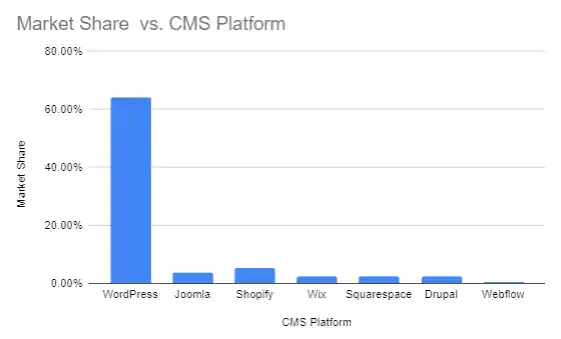
Below is a 2021snapshot based on W3Techs CMS usage data, showing share of CMS-powered websites and share of all websites.
| CMS Platform | Market Share (% of CMS-Powered Websites) |
|---|---|
| WordPress | 64.1% |
| Joomla | 3.6% |
| Shopify | 5.2% |
| Wix | 2.4% |
| Squarespace | 2.3% |
| Drupal | 2.5% |
| Webflow | 0.4% |
WordPress: The Market Leader
Market Share: 64.1% of CMS-powered websites.
WordPress strengthened its position in 2021, extending its lead as the most widely used CMS. Its open-source nature, extensive plugin ecosystem, and broad hosting support made it suitable for a wide range of use cases, from blogs to business websites.
The platform benefited from growing demand for flexible and customizable website solutions. Its ability to scale alongside business needs kept adoption strong across industries.
Shopify: Rapid eCommerce Growth
Market Share: 5.2% of CMS-powered websites.
Shopify experienced significant growth in 2021 as online retail expanded rapidly. Businesses increasingly chose hosted ecommerce platforms that offered built-in payments, inventory management, and minimal setup complexity.
Shopify’s focus on commerce-first functionality made it a preferred choice for brands launching or scaling online stores, particularly among small and mid-sized businesses.
Wix: Steady Adoption Among Small Businesses
Market Share: 2.4% of CMS-powered websites.
Wix continued to grow in 2021, driven by demand for fast and simple website creation. Its drag-and-drop editor and bundled hosting appealed to users without technical backgrounds.
The platform remained popular among small businesses, freelancers, and personal brands that prioritized speed and ease of use over advanced customization.
Squarespace: Design-Centric Website Builder
Market Share: 2.3% of CMS-powered websites.
Squarespace maintained steady growth in 2021, supported by its strong design templates and controlled ecosystem. It attracted creatives, service professionals, and portfolio-focused businesses.
Its appeal centered on visual consistency and simplicity, making it a reliable choice for users who valued aesthetics and low maintenance.
Joomla: Declining Legacy Platform
Market Share: 3.6% of CMS-powered websites.
Joomla continued its gradual decline in 2021 as newer platforms gained traction. While still used by existing sites and certain institutional projects, new adoption slowed.
The platform remained relevant for organizations already invested in its framework but struggled to compete with more flexible and user-friendly CMS options.
Drupal: Enterprise and Institutional CMS
Market Share: 2.5% of CMS-powered websites.
Drupal retained a presence in 2021, particularly among government, education, and enterprise environments. Its strength lay in complex content structures and security-focused implementations.
However, its higher technical complexity limited adoption among smaller teams and non-technical users.
Webflow: Emerging Design-Led CMS
Market Share: 0.4% of CMS-powered websites.
Webflow showed early growth in 2021 as interest in no-code and visual development tools increased. It attracted designers and marketing teams looking for layout control without managing traditional CMS infrastructure.
While still a niche player at the time, Webflow began establishing itself as an alternative to conventional website builders.
Key Trends in the CMS Market
The CMS market in 2021 experienced accelerated growth rather than stability. Increased digital adoption, remote operations, and rapid online expansion pushed businesses and individuals to launch websites faster than ever before. Platform selection in 2021 was driven by speed, ease of use, and the ability to scale quickly.
Adoption trends reflected a strong shift toward flexible systems, ecommerce readiness, and simplified website creation, as users prioritized practical solutions over complex infrastructure.
Strong Growth of Flexible CMS Platforms
Flexible and extensible CMS platforms continued to gain market share in 2021. Systems that supported plugins, integrations, and custom functionality proved better suited to evolving website needs.
WordPress benefited most from this trend. Its open ecosystem allowed users to adapt sites quickly as requirements changed, supporting everything from content publishing to business and ecommerce use cases.
Rapid Expansion of eCommerce-Focused CMS Solutions
Ecommerce-focused CMS platforms saw accelerated adoption in 2021 as online selling became a priority for many businesses. Companies increasingly chose platforms designed specifically to support digital commerce.
Shopify experienced strong growth during this period, particularly among small and mid-sized businesses. Its hosted model, built-in payments, and inventory management tools reduced the technical barriers to launching online stores.
Growing Adoption of All-in-One Website Builders
All-in-one website builders continued gaining traction in 2021, especially among non-technical users. Platforms such as Wix and Squarespace benefited from increased demand for fast website deployment.
Bundled hosting, templates, and visual editors allowed users to create and publish websites with minimal setup. These platforms appealed to small businesses, freelancers, and personal brands looking for simplicity.
Early Momentum in No-Code and Visual Editing Tools
No-code and visual website creation tools began gaining noticeable momentum in 2021. Block-based editors and drag-and-drop interfaces reduced the reliance on custom development.
While still emerging, this trend signaled a shift toward more accessible website creation. CMS platforms that introduced visual building features positioned themselves for future adoption growth.
Performance and Ease of Management Gaining Importance
Performance and ease of management started to influence CMS selection more strongly in 2021. Website owners paid closer attention to load speed, reliability, and update simplicity.
Platforms that offered stable updates, managed hosting options, and reduced maintenance overhead gained user confidence. These factors began shaping longer-term CMS decision-making beyond initial setup.
Final Thoughts
The CMS market in 2021 was shaped by rapid growth and changing digital priorities. As more businesses and individuals moved online, demand increased for platforms that could support fast website launches, flexible customization, and scalable growth.
WordPress strengthened its leadership through its open ecosystem and broad adaptability, while ecommerce-focused platforms like Shopify expanded quickly as online selling accelerated. At the same time, all-in-one website builders attracted users who prioritized simplicity and speed over technical complexity.
Overall, CMS adoption in 2021 reflected practical decision-making driven by immediate needs. Website owners chose platforms that offered reliability, ease of use, and room to grow, laying the groundwork for the more mature and stability-focused CMS market that followed in later years.