
Content management systems power a large share of the web. Most websites rely on a CMS to create, manage, and deliver content efficiently.
The CMS market has reached a stage of stability. A few platforms dominate usage, while others serve specific needs. Adoption is driven less by trends and more by reliability, flexibility, and long-term value.
This report breaks down CMS market share, the leading platforms, and the key trends shaping how organizations manage digital content.
CMS Platforms Dominating the Market in 2019
By 2019, the CMS market had already reached a clear point of consolidation. A small group of platforms controlled the majority of CMS-powered websites, while long-standing systems either stabilized or began gradual decline. The data reflects a market driven by usability, scalability, and ecosystem strength rather than experimentation.
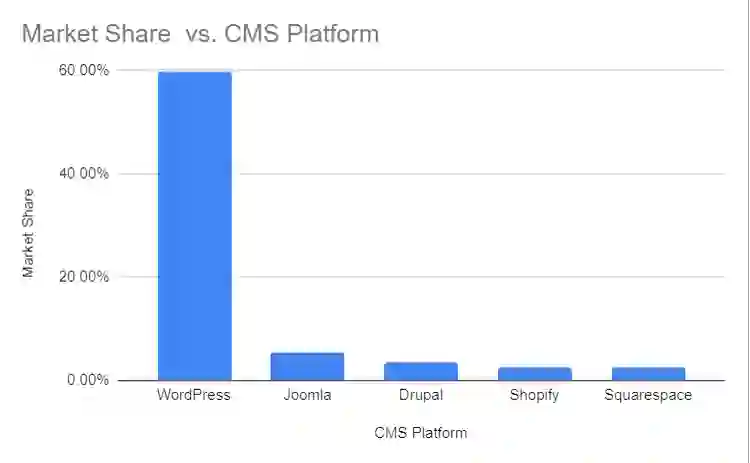
Below is a 2019 snapshot based on W3Techs CMS usage data, showing the share of CMS-powered websites and the share of all websites.
| CMS Platform | Market Share (2019) |
|---|---|
| WordPress | 59.7% |
| Joomla | 5.4% |
| Drupal | 3.5% |
| Shopify | 2.6% |
| Squarespace | 2.6% |
| Wix | 1.8% |
| GoDaddy Website Builder | 0.3% |
| Webflow | 0.2% |
| Duda | 0.2% |
| Tilda | 0.1% |
WordPress: The Undisputed Market Leader
Market Share (2019): 59.7% of CMS-powered websites
WordPress dominated the CMS landscape in 2019 by a wide margin. Its open-source model, massive plugin ecosystem, and flexibility made it the default choice for blogs, business websites, publishers, and even enterprise platforms.
The slight dip from earlier years did not signal weakness. Instead, it reflected market maturity. WordPress had already saturated most segments, leaving little room for explosive growth while still maintaining dominance.
Shopify: Rapid Growth in eCommerce CMS
Market Share (2019): 2.6%
Shopify showed strong momentum in 2019, more than tripling its market share since 2015. This growth came from a clear value proposition. Shopify was built for selling, not publishing.
Businesses that wanted fast setup, integrated payments, and minimal technical overhead increasingly chose Shopify over general-purpose CMS platforms. Its rise marked a shift toward purpose-built ecommerce systems.
Wix: Steady Expansion Among Small Businesses
Market Share (2019): 1.8%
Wix continued its upward trajectory in 2019, driven by small businesses and non-technical users. Its drag-and-drop builder, bundled hosting, and ease of use made it appealing for quick launches.
While it lacked the extensibility of open-source platforms, Wix succeeded by removing complexity. Speed and simplicity mattered more than customization for its core audience.
Squarespace: Design-First CMS Growth
Market Share (2019): 2.6%
Squarespace matched Shopify’s share in 2019, reflecting strong adoption among creatives, service providers, and portfolio-driven brands. Its tightly controlled design system and polished templates attracted users who prioritized aesthetics over flexibility.
The platform’s growth showed that design consistency and ease of maintenance could compete with customization-heavy systems in specific market segments.
Joomla: Gradual Decline of a Legacy CMS
Market Share (2019): 5.4%
Joomla remained one of the largest CMS platforms, but its market share continued to decline. Once a strong competitor to WordPress, Joomla struggled to attract new users as easier and more flexible platforms gained traction.
Most Joomla usage came from existing sites rather than new builds, signaling a legacy platform maintaining relevance without expanding adoption.
Drupal: Enterprise-Focused but Shrinking
Market Share (2019): 3.5%
Drupal maintained a presence in enterprise, government, and institutional websites in 2019. However, its declining share reflected growing concerns around complexity, maintenance costs, and development overhead.
While still powerful, Drupal increasingly served specialized use cases rather than the broader CMS market.
Emerging and Niche Platforms
Platforms like Webflow (0.2%), Tilda (0.1%), Duda (0.2%), and GoDaddy Website Builder (0.3%) remained niche players in 2019. Their adoption was limited but signaled early interest in visual builders and no-code workflows that would gain more attention in later years.
Key Trends in the CMS Market
The CMS market showed steady movement rather than sudden change. Traditional platforms continued to dominate, but the way teams managed and delivered content started to shift in meaningful ways. These trends highlighted what website owners and businesses were beginning to value more.
Move Toward Headless and Decoupled CMS
More teams started separating content from design. Instead of tying content to one website layout, they stored it in a backend system and delivered it through APIs.
This made it easier to reuse the same content across websites, mobile apps, and other digital channels. It also gave developers more freedom to choose their tools.
Early Use of AI in Content Management
AI features began appearing inside CMS platforms to support content teams. These tools helped with tagging content, organizing media, analyzing tone, and improving SEO.
AI was used to save time and improve quality, not to replace human decision-making.
Focus on Omnichannel Content Delivery
Businesses wanted their content to stay consistent across all touchpoints. Websites, mobile apps, chatbots, and digital platforms needed access to the same information.
CMS platforms responded by supporting centralized content systems that allowed teams to publish content across channels without duplication.
Faster Shift to Cloud-Based CMS
More organizations moved away from self-hosted setups. Cloud-based CMS platforms gained popularity because they were easier to manage and quicker to deploy.
Automatic updates, better scalability, and reduced maintenance made cloud solutions appealing to growing teams.
Stronger Focus on Data Security and Privacy
Data protection became a key factor when choosing a CMS. Platforms improved security features and gave website owners better control over user data.
Privacy compliance and trust started influencing CMS decisions more than before.
Return of the Modern Intranet
Large organizations revisited how they managed internal content. Instead of scattered tools, they moved toward centralized intranet platforms.
These systems improved collaboration, knowledge sharing, and internal communication across teams.
Growth of Content-as-a-Service
More brands treated content as reusable data rather than fixed pages. Content-as-a-service allowed teams to create content once and use it across multiple platforms.
This approach supported flexible CMS setups and faster content delivery.
Rising Importance of Video Content
Video became a major content format, increasing the need for better media management. CMS platforms adapted by improving storage handling and performance for large files.
Digital asset management has become an increasingly important part of the CMS ecosystem.
Conclusion
The CMS market reflects practical decision-making. Established platforms continue to lead because they offer proven ecosystems and dependable performance.
Flexibility, cloud adoption, security, and multi-channel delivery now guide CMS choices more than experimentation. Organizations favor systems that scale well and support evolving content needs.
Overall, CMS adoption shows a clear focus on stability, efficiency, and long-term usability.